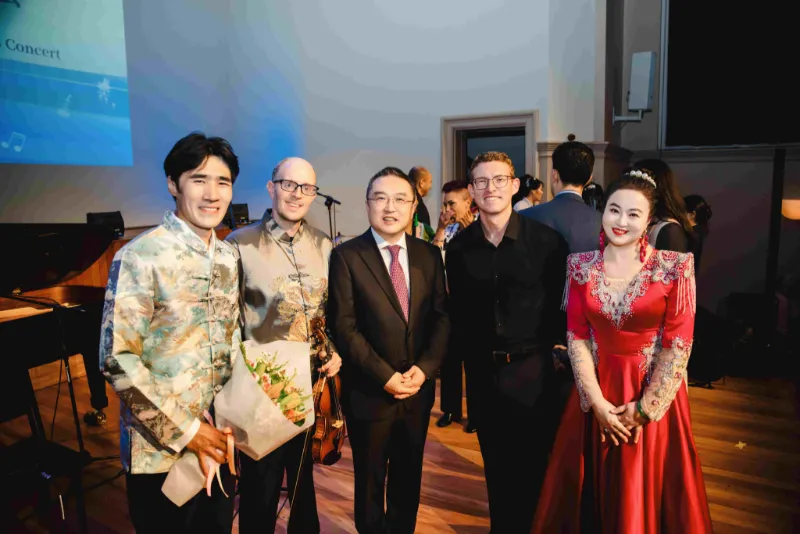
Dialogue · Zhiyin: Voices of the Earth resounded in Auckland on the evening of 18 May 2025. The concert, held at the Auckland Town Hall Concert Chamber, brought together Māori songs and Chinese poetry in an evening of music and cross-cultural exchange. The house was full, with an audience that included artists, cultural leaders and members of the public from across New Zealand.
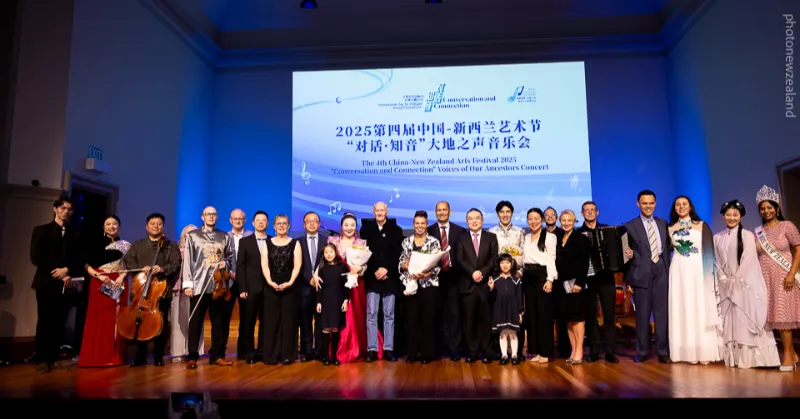
The event was presented by the Auckland Chinese Cultural Centre, co-organised by the Asian Community Engagement Trust (ACET), and supported by Guilin Property and Zhi Cheng Insurance. But more than a formal gathering, it was a meeting of two ancient traditions. Through voices and verse, the performance explored an idea that transcends language: that music can recognise and share what it means to be human, regardless of where we come from.
The title “Zhiyin” holds a special place in Chinese culture. It is not just about listening; it refers to someone who truly understands another’s heart through music. That idea shaped the entire evening. Rather than presenting Māori and Chinese works as separate showcases, the programme placed them in direct conversation. Māori melodies and classical Chinese poems were woven together with newly arranged chamber music, storytelling, projections and multilingual singing. The audience was not merely watching two cultures side by side; they were invited to listen for the connections between them.
Traditional Māori songs were carefully arranged and sung alongside Chinese lyrics, while Chinese poems were reinterpreted through the sensibilities of international musicians. Ancient poetry met contemporary performance, familiar melodies found new orchestral colours, and across all the different languages, the emotional core remained unmistakably human.
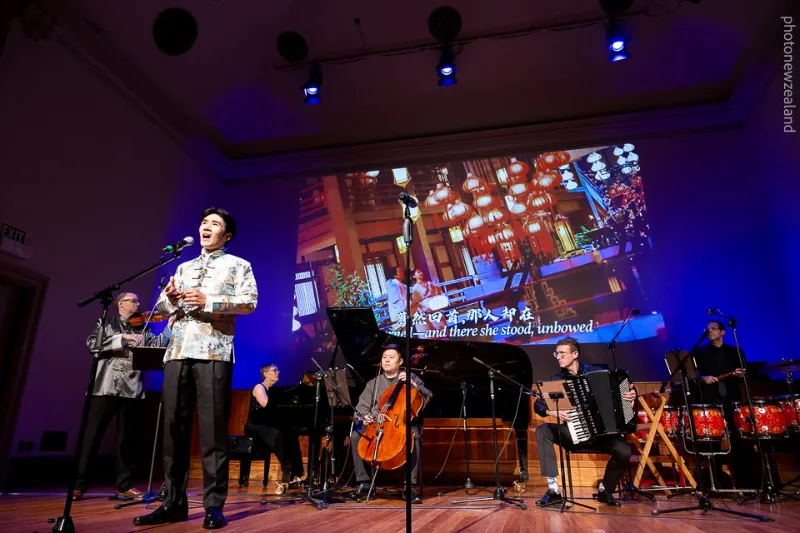
At the centre of the evening was Chinese baritone Nan Zhou, who served as both artistic director and lead performer. His voice combined emotional depth and dramatic power, and he moved naturally between Chinese poetic works and Māori musical traditions. He performed well‑known Chinese pieces such as “Qing Yu An · Lantern Festival,” “Song of the Chile Plains,” and “Po Zhen Zi,” as well as beloved Māori songs including “Tarakihi,” “Hine e Hine,” and “Pōkarekare Ana.” For Zhou, this was not just a performance; it reflected the role artists can play in building genuine connections across cultures. By singing the music of another tradition with respect and commitment, he turned symbolic exchange into shared participation.
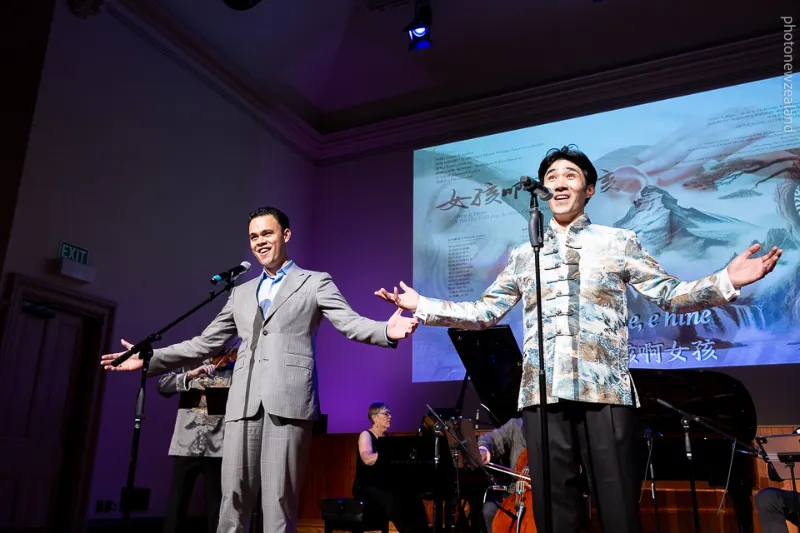
The international ensemble was equally remarkable. New Zealand baritone Eru Oneroa and soprano Alanah Jones joined the Chinese artists in a true exchange of languages and musical styles. In one of the most striking moments of the night, Māori singers performed Chinese poetry in Chinese—including works inspired by “Jinse” and “Da Jiang Dong Qu”—while Chinese singers sang traditional Māori songs in Māori. Language, far from being a barrier, became a bridge. Each artist stepped into the other’s musical world not as an outsider, but as a fellow participant. It was a vivid demonstration of what cultural exchange can look like when it moves beyond representation and becomes shared experience.
The chamber ensemble featured some of New Zealand’s finest musicians: acclaimed pianist Sarah Watkins, founding member of NZTrio; violinist Andrew Beer, concertmaster of the Auckland Philharmonia; world champion accordionist Grayson Masefield, who also teaches at the University of Auckland; Korean‑New Zealand cellist James Yoo, head of classical performance at the university’s School of Music; and Eric Renick, principal percussionist of the Auckland Philharmonia. Together, they created a distinctive sound that moved freely between Western classical music, Chinese poetic traditions and Māori heritage.
Dancer Liu Jiahui, a doctoral researcher at the University of Auckland, added another layer to the dialogue. In her piece “From Feng Qiu Huang to Bai Tou Yin,” she translated poetic emotion into physical movement, giving the poetry a visible presence that audiences could feel through both sound and gesture.
The concert was conceived as a continuous journey, not a series of isolated items. A dramatic narrative thread, centred on the idea of dialogue, connected each work through story, music and imagery. Dynamic stage projections and newly created arrangements gave ancient poetry and traditional melodies a contemporary setting. Each piece was reborn: Māori tunes were carefully transcribed and developed, Chinese poems were reframed through the language of an international ensemble. Words, melody, movement and design worked together to create an immersive experience that took the audience across time, place and tradition.
The stage direction was led by Chinese soprano Luxuan Liu, whose poetic approach and strong aesthetic sense shaped a visually immersive environment. Her design echoed the emotional depth of the music and the beauty of Eastern artistic philosophy, making the concert feel both intimate and expansive—rooted in tradition yet designed for a contemporary, international audience.
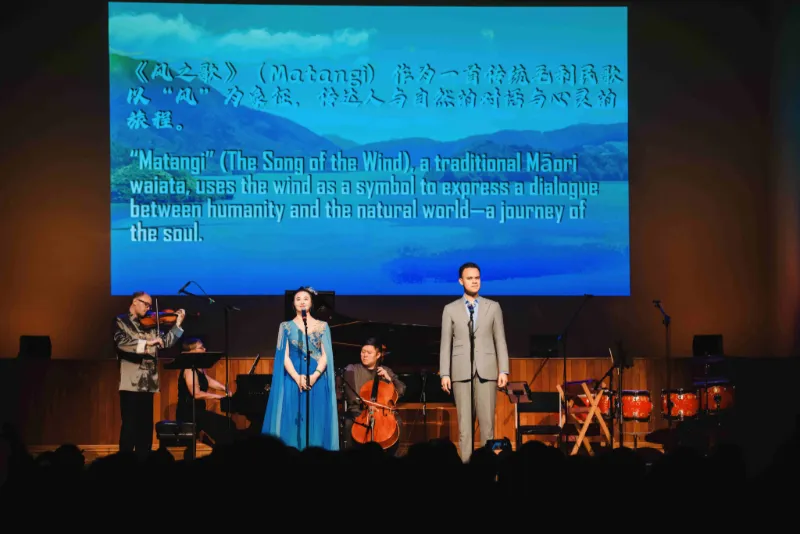
At its heart, “Dialogue · Zhiyin: Voices of the Earth” explored a simple but powerful idea: music can create understanding before words can explain it. Cultural dialogue does not require traditions to become identical; it requires only a willingness to listen. The Māori concepts of identity, connection to land and collective memory found unexpected resonance with the emotional and philosophical world of Chinese classical poetry. Love, memory, nature, longing, friendship, home—these themes have traversed centuries in both traditions, and on that stage they found a shared voice.
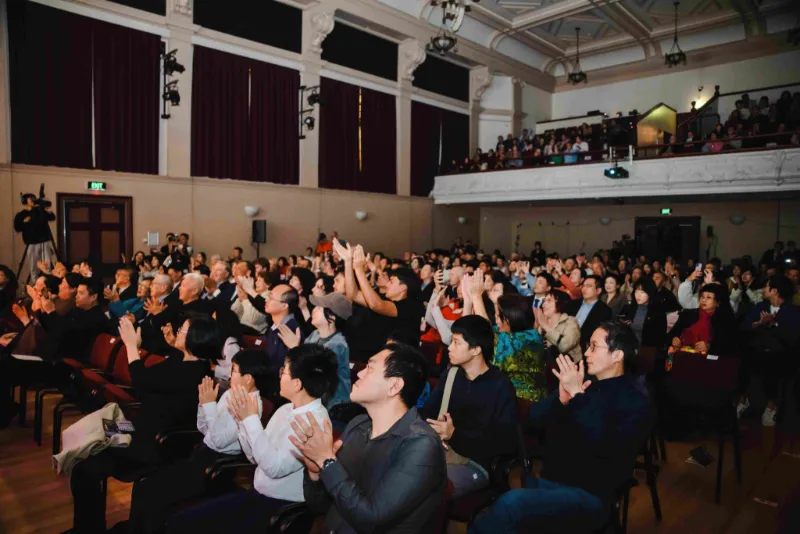
The evening was honoured by the presence of distinguished guests. Wang Xiaolong, Ambassador of the People’s Republic of China to New Zealand, attended and praised the concert’s creativity and innovative approach. Hon Tama Potaka, New Zealand Minister for Māori Development, came with his wife and greeted the audience in Chinese, drawing warm applause. In a particularly moving moment, Mrs Potaka sang an unaccompanied Māori song about the love of humanity, adding a deeply personal touch. MP Nancy Lu also delivered remarks. Other guests included Mike Dawson, President of the New Zealand China Friendship Society, along with representatives from cultural and community organisations. More than 300 people filled the hall, joining the artists in celebrating understanding through music.
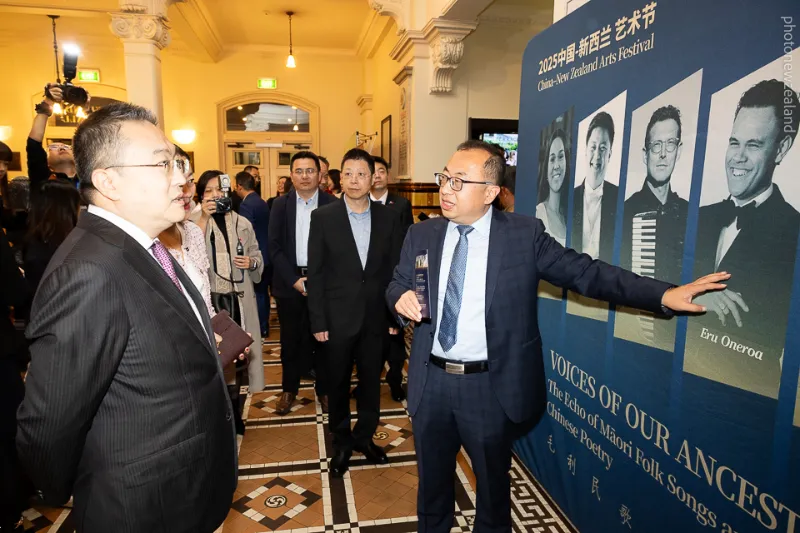
From a broader perspective, the significance of this event lies in what it represents. It was not a concert about one culture introducing itself to another; it was a concert in which cultures engaged in genuine conversation. Māori artists sang Chinese poetry, Chinese artists sang Māori songs, New Zealand musicians reimagined Chinese literary traditions, dance gave form to poetry, and classical chamber music became the meeting point for different artistic worlds. That is the deeper meaning of “Zhiyin”—to find someone who truly understands. And perhaps that is the ultimate ambition of cultural exchange: not simply to be seen, but to be heard and understood.
As the final notes faded and applause filled the hall, the evening’s meaning extended beyond its programme. “Dialogue · Zhiyin: Voices of the Earth” offered a vision of what cultural exchange can become—not a one‑way presentation, not a symbolic gathering, but a genuine artistic relationship. A relationship built through listening, through learning, and through stepping into another culture with respect. And in doing so, it showed that beneath different languages, histories and traditions, the human heart often recognises more than it expects.
On 18 May 2025, in the heart of Auckland, Māori songs and Chinese poetry did not simply share the same stage. They listened to each other, they responded to each other, and for one remarkable evening, they became part of the same conversation.